Where to Mail Form 941: Choose the Correct Address With or Without Payment
Reducing mailing delays by confirming what’s in your envelope
Before mailing a paper Form 941, check a few details. The right address depends on your business location and filing category. It also depends on whether you include a check or money order. Finally, it depends on whether you use the U.S. Postal Service (USPS) or a private carrier.
Overlooking any one of these details can send a return to the wrong processing center.
Current IRS instructions for 2026 tell filers to pay a balance online when possible. They also support online filing in general. Paper filing is still an option. This article explains the paper mailing addresses for USPS and approved private carriers.
Current 2026 Form 941 mailing addresses by state
The IRS groups Form 941 mailing addresses into four categories. One group takes priority over the others. Exempt groups, government entities, and Indian tribal government entities use a special address. Their state does not change it.
Other employers use the address for their state. A different row applies when a business has no legal home or main office in any state. That row also covers employers in American Samoa, Guam, the CNMI, the USVI, and Puerto Rico.
| Filing category | Without payment (USPS) | With payment (USPS) |
|---|---|---|
| Connecticut, Delaware, District of Columbia, Georgia, Illinois, Indiana, Kentucky, Maine, Maryland, Massachusetts, Michigan, New Hampshire, New Jersey, New York, North Carolina, Ohio, Pennsylvania, Rhode Island, South Carolina, Tennessee, Vermont, Virginia, West Virginia, Wisconsin | Department of the Treasury, Internal Revenue Service, Kansas City, MO 64999-0005 | Internal Revenue Service, P.O. Box 932100, Louisville, KY 40293-2100 |
| Alabama, Alaska, Arizona, Arkansas, California, Colorado, Florida, Hawaii, Idaho, Iowa, Kansas, Louisiana, Minnesota, Mississippi, Missouri, Montana, Nebraska, Nevada, New Mexico, North Dakota, Oklahoma, Oregon, South Dakota, Texas, Utah, Washington, Wyoming | Department of the Treasury, Internal Revenue Service, Ogden, UT 84201-0005 | Internal Revenue Service, P.O. Box 932100, Louisville, KY 40293-2100 |
| No legal residence or principal place of business in any state, including employers in American Samoa, Guam, the CNMI, the USVI, and Puerto Rico | Internal Revenue Service, P.O. Box 409101, Ogden, UT 84409 | Internal Revenue Service, P.O. Box 932100, Louisville, KY 40293-2100 |
| Exempt organizations, governmental entities, and Indian tribal governmental entities, regardless of location | Department of the Treasury, Internal Revenue Service, Ogden, UT 84201-0005 | Internal Revenue Service, P.O. Box 932100, Louisville, KY 40293-2100 |
For a general business filer in Colorado, this points to the Ogden address without a payment and the Louisville address with one.
The IRS has changed these addresses before. Check the current table each quarter instead of using an old address. The IRS Form 941 filing page shows the current version.
Some businesses include this check in their payroll support. Excol’s payroll services page offers Form 941 guidance for Colorado businesses.
Deciding whether your return counts as "with payment"
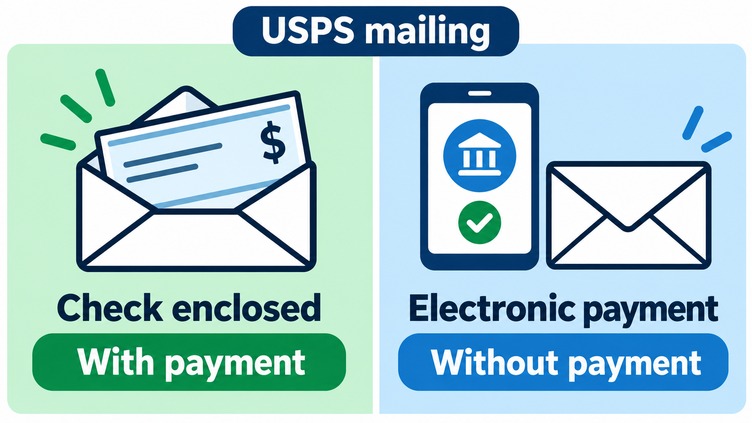
The address table depends on one key question. Does the envelope include a check or money order? That is what current instructions use, not just whether you owe a balance.
Two lines on the form serve different purposes. Line 12 shows total taxes after changes and credits that reduce the tax. This amount helps decide whether deposits are required.
Line 14 shows the balance due. It is the amount left after subtracting deposits shown on line 13. A business may need deposits based on line 12 and still owe a balance on line 14. The two amounts are not the same.
A de minimis exception may remove the deposit rule. This is a limit below which the rule does not apply. Under the March 2026 instructions, line 12 must be less than $2,500 for the current or prior quarter. The business also must not trigger the $100,000 next-day deposit rule in the current quarter.
Either quarter may meet the $2,500 part of the exception. Both quarters may qualify too. A balance under $2,500 alone does not create the exception. The line 12 limit and the $100,000 rule decide whether deposits were required.
When deposits were required, any balance on line 14 must be paid by EFT. EFT means electronic funds transfer. Current instructions do not allow a mailed check to replace a required deposit.
More payment options may apply when deposits were not required under the exception. They may also apply to a monthly depositor using the accuracy of deposits rule. A line 14 balance may then be paid by EFT, card, check, or money order. Online filers may also use electronic funds withdrawal (EFW). EFW can file and pay an eligible balance in one step. It cannot pay federal tax deposits and does not apply to paper returns.
The payment method can also change the mailing address when a check is allowed. See the Instructions for Form 941 for current payment guidance.
If you pay by EFT or card, mail the paper return to the without-payment address. Do not attach Form 941-V. If a check or money order is allowed, write the EIN, “Form 941,” and the tax period on it. Make it payable to “United States Treasury.” Include a completed Form 941-V and use the with-payment address.
Using a private delivery service instead of the U.S. Postal Service
An IRS-approved private carrier needs a different address from the P.O. boxes above. The IRS accepts only certain service levels from DHL, FedEx, and UPS for on-time filing. It does not accept every service those companies offer.
The current list of designated services is on the IRS private delivery services page.
Private carriers cannot deliver to P.O. boxes. Use the street address for the center that matches your without-payment category. This rule applies even when the package includes a payment.
- Kansas City Internal Revenue Submission Processing Center, 333 W. Pershing, Kansas City, MO 64108
- Ogden Internal Revenue Submission Processing Center, 1973 Rulon White Blvd., Ogden, UT 84201
The IRS private carrier address page lists all processing center street addresses. It includes Austin for other return types. Austin does not apply to Form 941.
Matching your category, payment status, and delivery method before you mail
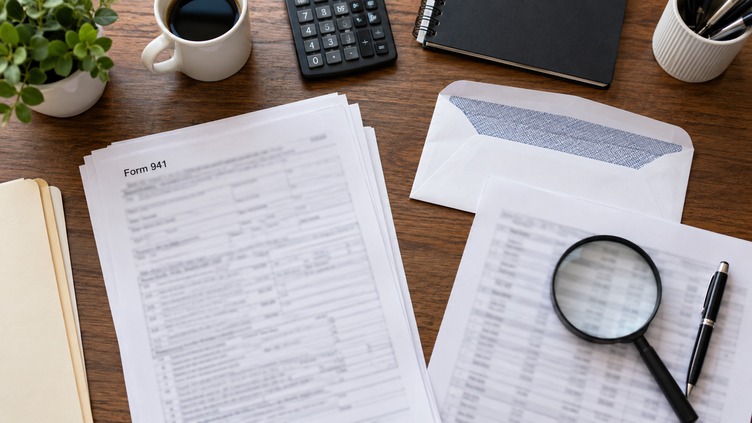
Check three things before mailing a paper Form 941. Confirm the filing category and whether the envelope includes a payment. Then confirm whether you will use USPS or a private carrier. We compare these details with current records and IRS instructions before a paper return goes out. Together, they point to the correct address.
Frequently Asked Questions About Mailing Form 941
I already e-filed my Form 941 for the quarter. Should I also mail a paper copy as a backup?
No. Current guidance calls for filing each quarter’s Form 941 only once.
If a return was already filed electronically, a paper version of the same quarter isn’t needed and shouldn’t be sent as well.
Should Form 8822-B be enclosed with Form 941 after a business address change?
No. Form 8822-B reports a business address or responsible-party change. Mail it on its own instead of placing it with Form 941.
I found an error on a Form 941 I already filed. Do I mail a corrected version to the same address?
No. Use Form 941-X to correct a Form 941 that was already filed. Send it as a separate filing instead of mailing a new or revised Form 941.
Does it matter if only the first page of Form 941 is filled out?
Yes. Form 941 requires both pages to be completed, including a signature on page 2.
A return that’s incomplete or unsigned can experience processing delays even when it’s sent to the correct address.
What is generally involved if a penalty notice is received after a Form 941 mailing issue?
Keep proof of mailing, such as a certified mail receipt. If you receive a penalty notice, current IRS guidance allows a written reply. Explain the facts in that reply. The IRS will review them to decide whether reasonable cause applies.
This is a fact-specific review handled by the IRS, and outcomes can vary based on the details involved.